
Most of us "learned" geography once, for a test, and forgot it a week later. Then a place comes up in the news, a friend says where they're travelling, or a movie is set somewhere, and there's that small blank moment: where is that, exactly?
The good news is that geography is one of the easiest subjects to learn for good, if you learn it the right way. It doesn't take long sessions. It takes a few minutes, most days, with the right kind of practice.
Why geography doesn't stick (usually)
- We cram. A long session once in a while feels productive, but memory fades fast without repetition.
- We only recognise, we don't recall. Looking at a labelled map feels like learning. Finding a place on a blank map is the real test.
- We learn places one by one. Places are easier to remember next to their neighbours, with a name you can say and a fact or two attached.
A method that works
1. Practise a little, every day
Five minutes a day beats an hour once a week. Short, regular practice gives your memory a reason to keep what it learned.
2. Learn in small neighbourhoods
Take five or so neighbouring regions at a time. Learn the name, how to say it, the capital and what it borders. Each new place then has an anchor.
3. Test yourself by finding, not reading
Find the place on a blank map, or pick the right name from a few choices. Getting it wrong is part of it: the effort of trying is what makes it stick.
4. Review what you miss, spaced out
Bring back the places you got wrong after a short gap, then a longer one. This is spaced repetition, and it's the most reliable way to move something into long-term memory.
How Map Guess puts the method in your pocket
We built Map Guess to be exactly that: a calm geography game for a few minutes a day.
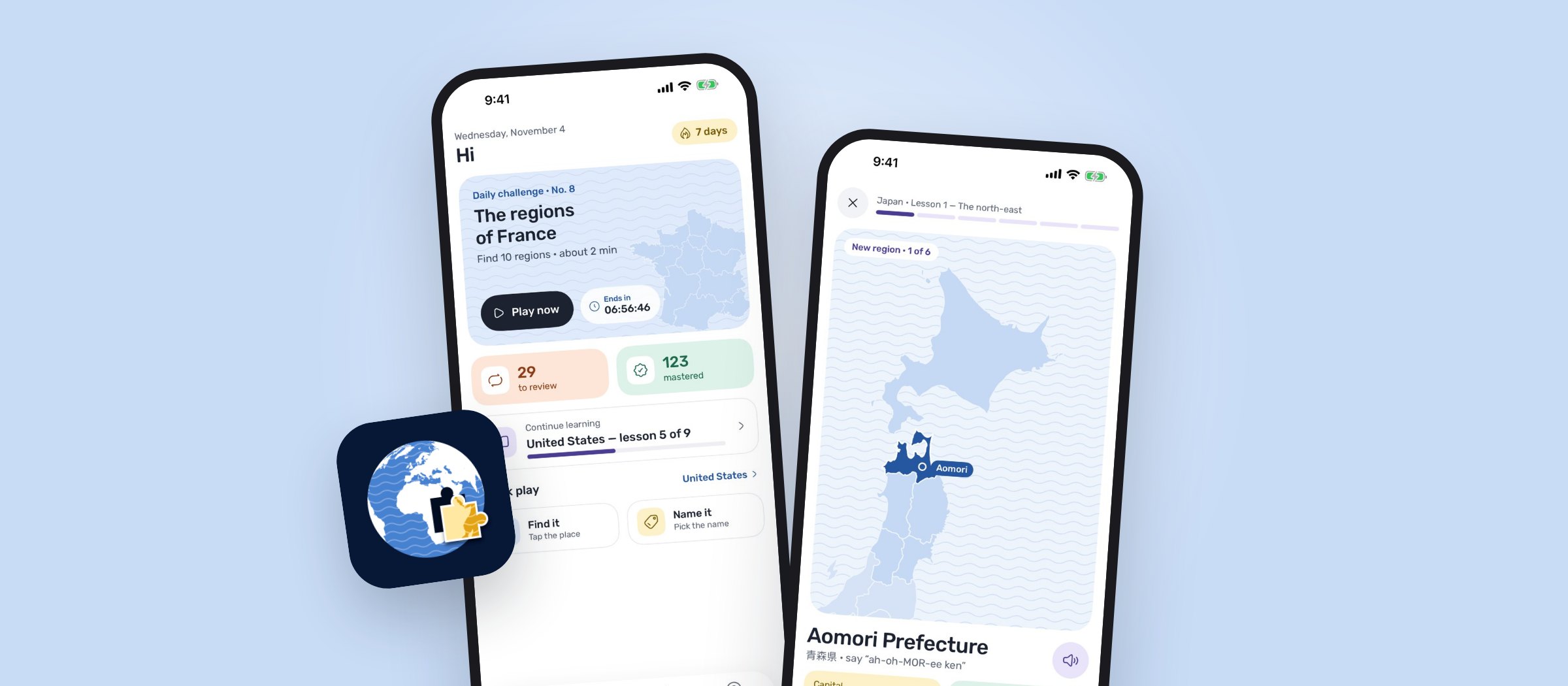
The Daily
One puzzle a day, the same for everyone: one map, 10 regions to find, and a new one at 00:00 UTC. It's always free. Your first try counts for your streak and the Game Center leaderboards, and you can share your result grid without spoilers.
Short lessons
Each lesson covers about five neighbouring regions, with the local name, how to say it, the capital and its borders. It's the "small neighbourhoods" idea, built in.
Two ways to practise
Find it: tap the place on the map against the clock. Name it: pick the right name from four. One trains recall, the other trains recognition, and together they cover both.
Smart review
The places you missed come back, spaced out so they stick. Your mastered count grows as you go, which is a nice thing to watch on a slow Sunday.
Explore, just for curiosity
Tap any country on the globe, or any place on a map, to see what's there. Drag to spin, pinch to zoom. Explore is free on every map.
What you can learn
Map Guess covers the world, the six continents, and the states and provinces of 23 countries, with current borders and names. A good path:
- Start with the world map and the Daily, to get your bearings.
- Pick one country you care about, maybe where you live, or where you're travelling next, and do its lessons in order.
- Let review do the rest. Open the app for the Daily, clear your review, and you're done for the day.
Make it a habit
- Attach it to something you already do, like your morning coffee or the commute home.
- Protect the streak, but don't worship it. Missing a day is fine. Coming back tomorrow is what counts.
- Play with someone. Comparing Daily scores with a friend or your family is half the fun.
Map Guess is free to play on iPhone and iPad: the Daily, every mode on the world and continent maps, Explore on every map and the first lesson of every map, with a few ads. Plus unlocks every map and lesson, smart review across all your maps, a weekly streak freeze and no ads.
A few minutes a day, and in a month you'll know where places are. Not for a test this time, but for good.